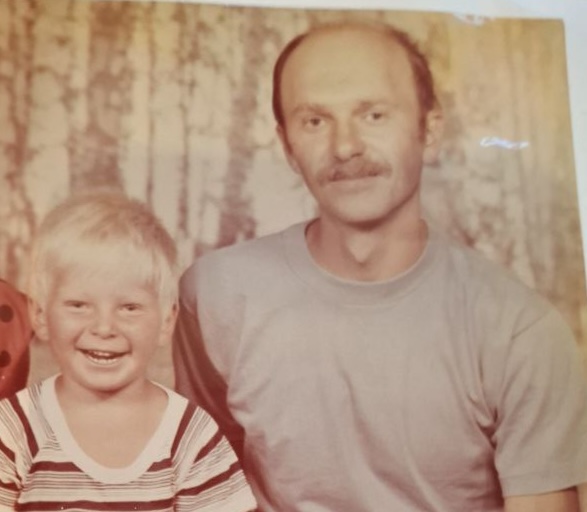
Me Father Me
Part 1
I think this is an unusual story which, at the same time, is sadly all too ordinary. The last time I saw my father I was twelve. I’m thirty-seven now. My parents divorced when I was four. Naturally, it wasn’t a peaceful separation, and just as naturally, I was the reason for it.
The first years with a child are a serious test for a relationship. From what I understand, the core of their disagreements lay in how I should be raised, and my father’s methods were far from conventional. I’d love to give a concrete example, but do I really remember? Something everyday and trivial – to fasten or not the top button on a shirt, or which should be the temperature of the bath water. He also had the patience and calm to defend his point of view using well-structured logical arguments – a trait I inherited, and which, when activated, can still drive my mother up the wall.
As it usually happens, the arrival of a child brought long-dormant tensions in the couple to the surface.
It’s one thing to live a carefree student life in the 5th dorm of the math department, room 314, where I spent the first ten months of my life: just one room, metal beds, and a communal shower at the end of the hallway. Strolls through the university park with the stroller, and my entirely natural — though not exactly voluntary — presence at my mother’s fifth-year lectures in the more exotic areas of applied mathematics. Such environment can shape the way of thinking. Maybe that’s why the only line from my father’s letter to my mother, sent to the maternity hospital, that stuck in my memory was something about a “little kitten and a subkitten.”[1]
And it’s entirely different to start a new life together in the settlement of Svetlodarsk in the Donetsk region, where my parents moved after university. He had an own apartment there. A questionable reason to move out of sunny Crimea, especially on the eve of the USSR collapsing [2]. My mother earned some money by solving coursework assignments, while my father went to work in the coal mine.
. It was customary there to down a bottle of moonshine after every shift, but my father envisioned his future in science. In his free time he tried to prove Fermat’s theorem – mostly locked in the bathroom. Needless to say, he never fit in with the mining community. My mother feared that in the event of an accident underground, they simply wouldn’t bother trying to save him. So she asked him to quit. He went to unload freight cars instead. When her maternity leave ended, she became an IT teacher at a school.
By then, their relationship was over. No warmth, no love. Attempts to hurt each other gave way to indifference. My father wasn’t hiding the fact that he had someone else on the side.
For the relatives, they pretended everything was fine – they even all went to the seaside together for my mother’s vacation, to see my grandparents. But there was nothing left between them. I was the only thread holding them together.
Each of them wanted to keep me exclusively for themselves, which of course was unacceptable to the other.
When the divorce finally reached court, my father’s only hope of winning was deception – which he attempted, unsuccessfully, accusing my mother of alcoholism and drug use. After that, even though the court ruled in her favor, my mother no longer felt safe. She was afraid that one day my father would simply take me away to God-knows-where (and, as we later found out, not without reason). The fear of losing her child outweighed the fear of family judgment. My grandfather arrived with a dump truck, my mother took me and the cat, and we returned to Simferopol (Crimea). My father stayed in Svetlodarsk, in his apartment.
We never lived together again, and since then I’ve only seen him a handful of times.
Everything above is reconstructed from my mother’s words. I barely remember anything from my earliest years, so I want to fix the few images that are still accessible to me.
There’s a lightness in writing this – here, I don’t need to worry about accuracy or fear distorting anything. Whatever lives in memory is my truth, and I value the fact that it’s still with me.
A long wide hallway with a red carpet leading straight to the bathroom. My father bends his head under the faucet, washing away blood. I’m standing next to him, anxious. On the left is my room with a climbing wall, a rope, maybe gymnastic rings, and some sort of “nest” above. On the right were the kitchen and another room. A small wooden rail with a string was attached to the kitchen window, and a piece of sausage was hooked to it. They’d give a command to Murzik the cat, and he would leap for the sausage, stretching out beautifully in mid-air.
Once, I walked out of kindergarten on my own. I waited for my parents at the entrance of the building and was immensely proud of myself. At night, my father told me stories about flying squirrels. And political news. I remember retelling the events of the 1991 Soviet coup to some adults, and they listened in amazement while I couldn’t understand what was so impressive about it.
I remember teasing a kid named Denis in kindergarten: “Denis-radish, I’ll eat you up!” He snapped back: “Nikita-drinkita, I’ll drink you!” I was outraged by the illogic – there’s no such word as “drinkita,” so logically he couldn’t drink me.
I remember the silhouette of Lenin outlined against the deep blue sky [3]. One of my parents pulling me by the arm (or the leg) trying to take me home from the playground, while I clung to a piece of metal with all my strength. A flash of sharp pain – it seems they dislocated my shoulder. I cried. There were sticks of every possible size standing in a corner by the front door, which my father and I collected during walks.
And the most vivid and tangible memory: the sensation of swimming. In the cooling reservoir near the power station, I swam for the first time – underwater, but I still remember the astonishment of discovering this new kind of movement.
And then – nothing, until the next memory, already from Simferopol. I’m crawling around the room with a toy truck, collecting threads from the floor into the bed of the truck. My mother is delighted, because I’m helping clean the room. The scraps of thread were there because she had been sewing something on the sewing machine. She made so many beautiful and unusual clothes for me when I was a child. It’s sad that I don’t remember them. But I do remember the strawberry-flavored toothpaste that I simply ate like candy.
My father appeared only four more times after that.
The first – to file an appeal in court and try again to win custody. He failed.
The second – he secretly took me from kindergarten and tried to run away with me. My mother intercepted us at the train station. Amazingly, I remember nothing of this.
The third – just to see me, when my cousin and I were spending the summer with our grandparents. She was the first to spot him walking toward the house and was frightened. I remember her running across the yard, breathlessly trying to tell our grandmother something, with my father’s silhouette in the open gate behind her.
The fourth – the last time I ever saw him – I’ll describe later. It was brief and nothing came of it. Shortly before that, he had sent me a package: pine nuts and a pair of his worn jeans. By then he had moved to Russia and lived somewhere deep in Siberia.
The jeans didn’t fit. I grew up without him and never really missed him. He was just… absent. I didn’t even call him “father” in conversation. At best – a neutral by name “Roma.” And sometimes, with a certain distance – “my biological dad.”
Part 2
I grew up without him and never felt the lack of a father. Not at school, when I could spend hours in the bathroom solving group C problems from Skanavi[4]. Not at university, where I studied in the same faculty, sometimes with the same professors, sitting at the same desks he once had. And certainly not later, when, in the late-night haze of cognac and preferans, I was introduced to the culture of preferans (a classic intellectual game widely played in the Soviet academic community). Nor when I first climbed Mount Chatyr-Dag, nearly coughing my lungs out, knowing with absolute certainty that my parents had climbed the same mountain when my mother was pregnant with me.
I don’t recall more direct traces of him. But rest assured: among all the meaningful – and especially the not-so-meaningful – episodes of my life, it would be hard not to spill them all here in a jumble: aikido, the first kiss, the first fight, hikes, books, girls… yet in none of these moments did I feel a need for him, nor regret that he was absent.
Strangely enough, all the women with whom I ever had a deep connection also grew up without fathers. And in those relationships, our missing fathers became an unexpected supporting pillar – a plank in the bridge that brought us closer together.
Later, when it became fashionable to dig into one’s past in search of childhood trauma – not out of necessity, but more out of curiosity, when someone would share their discoveries in conversation – I, too, peered behind the veil of time, almost under a microscope, trying to detect how my father’s absence had shaped me. And I found nothing. No impact. No insights. No other reasons to think of him at all.
I married a woman from a complete family. Not that it was a conscious criterion – not at all. Before her, I had several serious relationships. Good ones, which I remember warmly and gratefully. But only with Ksenia did I learn to love. The list of life events in which I never thought about my father should also include the birth of my daughter. It happened a month before the full-scale invasion[5], and none of us had the luxury of indulging in reflection.
At the time, none of these realizations existed in my mind, so I suggest you, too, temporarily set them aside. Instead, join me in my ordinary life: remote work, a 2.5-year-old daughter, the search for myself in Berlin and for new meaning. And in this routine, within reasonable bounds, Instagram had long since taken a stable and comfortable place.
The story I’m telling is a chain of improbable coincidences – thin crossings of time and emotion through which I brushed against something irrational in life. Yet the first link of that chain was pure Instagram idling.
I noticed that one of my acquaintances from Crimea, who for years had been posting photos from City A, suddenly started posting from City B – Berlin, of course. We hadn’t spoken since the Crimea days, and even then we weren’t close: we worked at the same place, hung out in same circles, were generally aware of each other’s lives. After a couple of months of watching from the sidelines, I messaged him. We met, and he told me his story.
He had left his wife, leaving her with their three-year-old son. This is a brutal oversimplification that doesn’t convey the essence or depth of the crisis their relationship had entered – but for my story, that’s enough. His wife had found a new love. And their love had faded. My friend was faced with the classical dilemma: stay in the family for the sake of the child, or leave. For him, it looked like: “stay in my son’s life, showing him daily a man who is broken, unhappy, unloving, and untrue to himself, yet still present each day,” or “leave in order to reborn, to find new love, to regain strength, to build a new whole life – and invite his son into it later.” Again, oversimplified – he could talk for hours about that choice in every possible register as we walked along the canals of Neukölln. More than a year has passed, and he still talks about it. Interestingly, he grew up in what you would call a complete family. His parents are still together, and he has a good relationship with his father. So there we were: two emigrants, two young fathers, mirror-image family histories.
At that time, he was very vulnerable. Despite having made his choice, he returned to it constantly. He talked to therapists, searched for people with similar childhood experiences to understand how their father’s departure had shaped them. He shared an observation: the “Western” therapeutic tradition tends to recommend leaving – with the idea of rebirth and later return. The “Eastern,” or more precisely “Eastern-Slavic,” tradition tends to advise staying in the family.
I didn’t connect his story to my own father. Instead, I immediately tried on his shoes. And such shoes fit no one, and certainly not comfortably. What would it be like to be with your child every day for the first three years of their life, and then stop being there? To tell them that dad is leaving, walking out of the home. And to go. To go and tear the bond with the most precious being in your world, and then carry that empty space inside you every day. Even now, thinking about it, I feel pain in my chest and my breath tightens.
Of course, he maintains the strongest possible contact, sees his son whenever he can; this bond is the main factor in every decision he makes. But it is not the same as living under the same roof.
He became the first male friend with whom I could truly share – or rather reflect on – the experience of fatherhood. Correlation doesn’t imply causation – but several months after our talks, an unexpected realization arrived.
First: I had always looked at my father through my mother’s eyes.
Second: I did have a father. He was gone after I turned four, and I had grown accustomed to thinking he never existed at all. All my life I felt nothing toward him – no love, no warmth, no respect, no connection, no resentment, even. He was just a man from a photo who looked somewhat like me. And only after living through my own experience of fatherhood did I realize I could no longer dismiss those first years so easily.
I asked my mother whether he had loved me, whether he had been attentive, whether he had played with me. And, of course, the answer was yes.
I had a father. I had this big, wonderful man who was always glad to see me, who could throw me into the air and catch me, who looked at me with happy eyes while I touched his stubble, who supported me with his gaze, held my hand gently, and showed me the world.
Sometimes, when my daughter falls asleep in my arms, I carry her home for fifteen minutes, carefully lay her in bed, and even from another room I feel the connection physically – countless golden threads running from her chest to mine, pulsing in sync with her breathing. I don’t know how he felt with me, but I cannot imagine it being fundamentally different.
One warm thought shattered the stone of indifference under which the image of my father had lain. I suddenly felt sorry for him. First he and my mother couldn’t make a life together; then he behaved like an idiot during the divorce; then, however life turned out for him, I cannot imagine that he did not regret losing me. Maybe he was a fool three times over, and I don’t know why he never reached out once social media appeared. But he was the man who told me about the flying squirrel, held my hand, showed me the first frames of the film called “life,” and for a while, he was my whole world. I have no other person like that. He loved me. And that is enough.
I realized I wanted to reach out to my father. But first I had to find him.
Part 3
He had no social media accounts under his real name. But the Internet is bigger than social networks. By some miracle, I stumbled upon a website created by volunteers specifically for searching people by their digital traces. Interestingly, now, a year after the events described, the site no longer works… the right doors open when they need to. But back then, I could put only one piece of bait on the hook—my father’s full name and date of birth—and cast them into the murky waters of a leaked personal data database. Fishermen always look calm on the outside, but who knows what happens inside them when they feel a bite on the line. The first thing that surfaced was his address, which I already knew—the one he used to send me pine nuts and his jeans from: Khanty-Mansi Autonomous Okrug, Nizhnevartovsk District, Izluchinsk settlement [6]. I don’t remember the exact street and building anymore, but it was definitely him, and that match allowed me to trust the search results.
Soon I had several phone numbers, a few email addresses, his taxpayer number, and even his login and password for an online electronics store. Without much hope of a response, I sent short emails:
“Hello, I am looking for my father, Roman Levintsov. If this is you, or if you know him, please let him know that his son Nikita would like to speak with him. You can reply to this address. Thank you.”
And I put “from Nikita” in the subject line.
What would he feel when he saw a familiar name from another life?
Calling the phone numbers was harder. What if he actually answered? The words would freeze in my throat as I listened to the long beeps on the other end of an unreal, never-come-true world. But I didn’t have to speak—all three numbers turned out to be inactive. I wasn’t rushing: I spent no more than an hour a day searching, and I never called more than two numbers in one day. Each time I had to brace myself, choose the right moment, the right emotional state. I asked myself again: why? The answer was right in front of me—Maya and our bond.
One of our little traditions is jumping on the ball—technically, on a 1.2-meter Pilates ball that I wedge against the couch with my knees while Maya bounces on it like a trampoline, holding my hands. It’s a surprisingly exhausting activity that can go on for half an hour. But I never stop her—I try to memorize her mid-air smile, the sparkle of joy in her eyes, the way she laughs, the way her hair flies, so similar to mine. I don’t know how life will unfold, but our moments with Maya—nothing can undo them, they already exist, recorded in her and my biological blockchain. Actually, in something bigger than biological: I think such pure feelings become part of the world itself, woven into the fabric of eternity. Against that background, his crappy behavior, his absence for almost my entire life—yes, it is sad, but infinitely small. So I continued. One of the numbers was answered by a woman. She was clearly not thrilled to hear his name. She asked not to call again and never picked up afterwards.
The electronics store was much friendlier: “Hello, Roman Petrovich, you have 0 active orders.” The login and password worked, and the detective thrill quickly turned into shock: this was the most real contact I’d had with him in 25 years.
I kept experimenting with database searches, using the details I had found: phone numbers, his taxpayer ID, combinations of name and surname, surname and birth year.
Soon I got truly lucky—a new address appeared: 150010 Yaroslavl, Frunzenskiy District, Oktyabrsky settlement, Building 12, Block 2, Apartment 50. Of all the cities in this gigantic country, he had settled in Yaroslavl—my wife’s hometown. Or so I thought; I didn’t yet know if he really lived there. But at least this could be checked, because her parents still lived there.
- “Hey Ira, I need a favor. Could you check out an address? Nothing crazy, I’m just trying to find my father and the Internet gave me this address.”
Ira called back a couple of days later. No one opened the door of apartment 50. But neighbors confirmed that a man named Roman lived there. He didn’t talk to anyone and worked at a nearby factory. They last saw him at the end of summer, and it was already November 10, 2024. Ira left her contact information and asked them to let us know if he showed up.
I still didn’t allow myself to believe that I had found him. I cut off every attempt to imagine our meeting. I was processing. And then, a couple of days later, some of Ira’s acquaintances from the factory sent her a recent photo of him, taken at a workplace gathering. The quality was mediocre, but enough to convey warmth, kindness, and sadness in his eyes. It felt like he was looking not at half-drunk coworkers but at me—as he did in my distant childhood. Through a phone screen I felt his warmth; I saw our resemblance… and in that moment I finally recognized and accepted him. I couldn’t hold it back anymore.
It seems that we will meet in Turkey, on the Adrasan peninsula, where it’s still warm enough for camping, where there is a sea and mountains that look like Crimea, and where you can live for a week on the shore and no one will bother you. I closed my eyes and dissolved into the visions. No need to endlessly exchange stories of our lives—at least, that can wait.
We could just be together: dive from the rocks, catch crabs and shrimp, gather firewood, watch the stars. When he left my life, I was exactly the age that Maya is now, and he could, in a sense, return to that point 34 years ago and continue the path of fatherhood from where it had broken off. Could meeting Maya heal him?
These were not just fantasies, the kind someone would imagine if asked to describe how meeting their father might look. No—I was living those scenes. I could feel the salty splash on my cheek after he jumped into the clear water from a SUP board. I could taste the milk-buckwheat porridge he cooked for breakfast over the campfire. I could feel the weight of his hands on my shoulders. The warmth of his voice. I don’t know how, but he was there with me. And I was living through the brightest part of childhood with him—the part that never existed. Those vivid, present-tense visions lasted several days, until I resurfaced from the whirlpool of memory.
There were still no news from him. All I could do was wait, digesting the event of almost-finding my father and trying not to wind myself up with expectations. It wasn’t that difficult, especially thanks to my growing daughter who, unlike her grandfather, was not planning to disappear from my life.
Speaking of grandfathers—there would be no news about my father for another six months, so let’s step away from him for now. It would be wrong not to speak here about my grandfather, my uncle, and my stepfather. I thought about them a lot while living through—and later writing—this story. Each of them was present in my life, each of them shaped me, each gave something and sacrificed something for me. They sketched the contours of the so-called “father figure,” and with the arrival of my daughter, I am filling those contours with color and volume—becoming a father not only to her, but to myself as well.
I spent every summer at my grandparents’ village near Eupatoria[7] until they moved to Israel to have my grandmother’s heart surgery, extending her life by ten years. My grandfather had a house he built with his own hands, a garden, a shed with chickens, a workshop full of coal and tools, cassettes of Kadysheva’s songs[8], a yard with peaches and apricots, a habit of starting conversations with strangers on the bus to the sea, and an endless arsenal of stories to support that habit. He taught me that the best shashlik is from a young lamb, on Builder’s Day[9], when the whole family gathers in their home, and the best cucumber is the one you pick fresh from the garden and rinse with water from a hose.
I watched him carve an airplane out of wood—four propellers from a tin can, landing gear from a thread spool, painted yellow. You could spin it on a string and make it take off and land; the propellers moved, the landing gear worked. My grandfather had served as an aircraft mechanic, describing his job with irony as “eliminating the gap between fabric and wing surface.” I helped as much as I could: painting and hammering in the nails for the propellers. You could see him on the streets of Irpin until 2023—despite trembling hands he still made weathervane toys, went outside to sell them, and never missed a chance to chat with buyers and passersby. If I had to choose one thing I got from him, it would be resilience.
My uncle… a legendary man, the only adult in the family whom I still genuinely miss. He infected me with the love for hiking, introduced me to science fiction, taught me how to catch crabs and all the tricks of outdoor life. He got me a summer job after ninth grade in a double-glazed-window assembly shop. There he taught me how to behave in a men’s workplace, including keeping a straight face while peeing into a sink. He got me hooked on word games, “contact,” “what-where-when,” twenty questions, and intellectual play in general. Thanks to him, I’m not embarrassed to swim naked or go to bed in the middle of a party if I feel like it. My uncle showed me the value of originality and gave me a taste of adventure.
And my stepfather appeared when I was eleven. He was a programmer long before it was mainstream. I used to visit my mother at work—in the bank, where they met. There “Uncle Sergey” showed me StarCraft and how to find secrets in Doom. Thanks to his subtle influence, I tied my life to programming, a decision I never regretted. He also took me to work, taught me .NET and how to write stored procedures. He was always calm, never pressured me, never lectured. Maybe he appeared too late to change the foundation of who I was, but he was always there—for my mother and for me. With his stability and perseverance he created a foundation on which I could grow in my own way.
Part 4
July 3rd, 2025. My friend and I are devouring an amazing döner in Friedrichshain. I almost haven’t thought about my father lately — there have been no updates at all. A message from Ira arrives:
- “Nikita, sorry. Please call when you can.”
I call. It turns out they found my father dead in his apartment. The neighbors noticed a strange smell, called the police, and they broke the door. According to them, the body was far from fresh.
He was 65 — not old by today’s standards. He died alone, and there was not even anyone to bury him. But apart from freezing up from direct contact with death, I didn’t feel anything. Condolences from my mother and aunt were misplaced — his passing wasn’t a real loss. What I regret is the unrealized experience, now permanently lost, for both him and me.
Two days later I was hit by a shocking realization. If anything deserves to be called an insight, this was it — short yet immense, and it will take far more words to explain than to state:
I had been in his Bardo.
What?
Don’t worry if that means nothing to you. By my estimation only a few thousand people in the world — maybe tens of thousands — know what Bardo means. But I’ll try to explain. Bardo is a concept from the deep layers of Human Design — deeper than “Projector,” “strategy and authority,” “Generator 1/3,” and other types and profiles. I encountered this knowledge eight years ago, dove into it, and now I see reality on a different level.
Bardo is the transitional stage between life and death — the final conscious “journey” of the soul. If we assume that a human has an immortal (reincarnating) essence, usually called the soul, then after physical death the soul is shown what the current incarnation was about. Among other things, this may involve a “meeting” with people important to the dying person. I realize this is thin ice — to describe what happens after death — and I don’t claim any kind of ultimate truth. But this is my story, and this is how it unfolded. It was the closest brush with the irrational I have ever experienced. In that moment, I needed no proof or analysis — I simply understood what those visions back in autumn had been. That was when he died.
Bardo happens within 72 hours after physical death. It is our right to a final journey. But not everyone goes through it. There is only one requirement: during those 72 hours the body must not be touched (moved, burned, buried), otherwise the Bardo ends or never begins. And if there is anything good about the fact that he was alone, that he lived who knows how many of his last years in solitude, it’s that after his death nobody disturbed the body. Not just for 72 hours — for almost half a year. The heating in the apartment had been shut off, snow lies in Yaroslavl until May, the front door was tightly closed, and the windows were double-pane. The smell only troubled the neighbors in summer, when the temperature finally rose.
How far back can one look to trace the chain of events that led to this point?
An Instagram post. Growing close to a friend who had his own family difficulties. Seeing my father for the first time with my own eyes, not through my mother’s stories. The search. Yaroslavl — where he settled — the hometown of my wife whom I met in Kyiv. My visions… and his Bardo. I spent a week in reverent shock after realizing what had happened, when another memory surfaced — of the last time I saw my father. I promised to tell this story at the beginning.
He came to visit when I was thirteen or fourteen. My mother let us talk alone in the courtyard. We spoke for no more than an hour. I was clearly skeptical toward him. I made it clear that when we needed help, he didn’t support either my mother or me, and now it was too late — the train had left, I didn’t need him. That part remained in memory — something I always knew and never revisited, treating it as an insignificant episode of life.
A week after I learned of his death, another image from that meeting emerged — one I had never recalled before: his eyes filling with tears, his face twitching with suppressed crying, the look of hope in his gaze as I calmly told him he was a stranger to me and that I didn’t need him. This scene returned again and again, and now, living through the pain, it was I who shook with sobs. But I didn’t drown myself in guilt. Replaying that memory, I re-lived and re-wired it. Instead of cold rejection I told him I was sorry life turned out this way, that I knew he had loved me all along, that I accepted him, that I was his son and he was my dad. Again and again, for days, until the pain dissolved, the wrinkles around his eyes smoothed, and he simply looked at me with a gentle gaze of blue eyes.
Nick Polonsky
14 November 2025
Out of weakness, out of foolishness, out of circumstance, out of pain.
Because they were given no choice.
To those who were judged, forgotten, erased.
To those who could never forgive themselves.
To those who, despite everything,
carry love for their children inside.
Those who find,
and those who forever lose
the chance
to show that love.
I have no love for graves, nor do I know where they buried you — and even knowing, I wouldn’t come.
Yet I want there to be a place for you and me here.